iya clinic
PRP for hair loss: realistic benefits, limitations and preparation

PRP is often presented as a universal way to “wake up” hair growth. In practice, response depends first on the diagnosis and whether follicles remain functional. Plasma injections cannot create new follicles in scar tissue, correct iron deficiency or treat thyroid disease. They should not replace an investigation into why hair is shedding.
Most clinical research concerns androgenetic alopecia: gradual patterned thinning in men and women. Reviews suggest that PRP may improve hair density or count in some patients, but preparation methods, treatment schedules and study quality vary. It is therefore more accurate to discuss a possible supportive effect than guaranteed regrowth.
What scalp PRP actually is
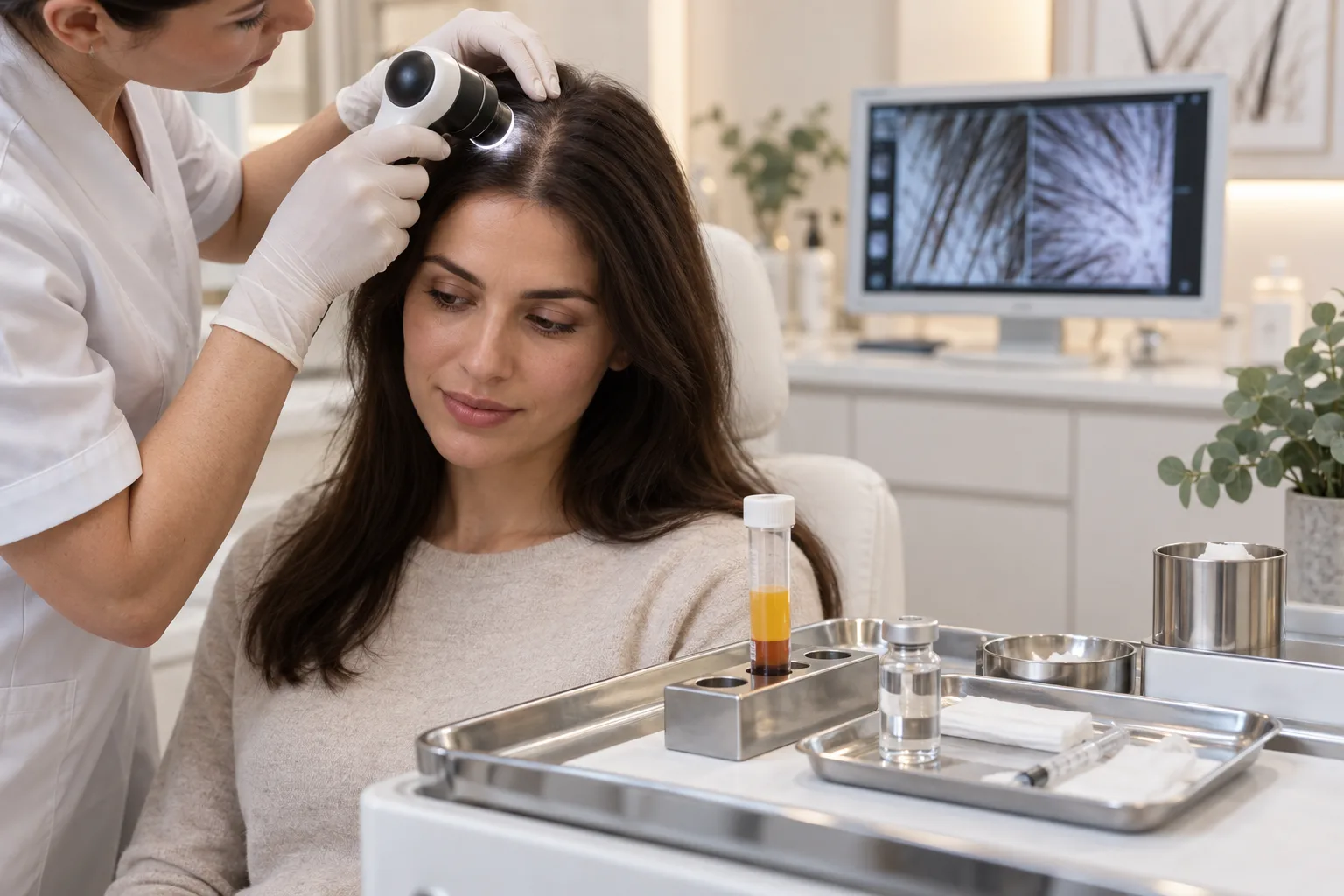
PRP means platelet-rich plasma prepared from the patient’s own blood. A small venous sample is processed in a centrifuge to separate its components. The selected plasma fraction is then injected in small amounts across the treatment area.
Platelets contain signalling molecules involved in tissue repair and cell communication. The proposed aim is to support the environment around viable follicles and the growth phase of hair. The final product differs between systems: platelet concentration, white-cell content, activation, volume and injection technique are not standardised. This helps explain why results from different studies cannot always be compared directly.
PRF is a related autologous product containing a fibrin matrix and different release characteristics. PRP and PRF are not simply two brand names for an identical injection, and PRF is not automatically “stronger”. A clinician should identify which product is being used and why.
| Approach | What it uses | Possible role | What it cannot do |
|---|---|---|---|
| PRP | Concentrated platelet-containing plasma from the patient | Support viable follicles in selected diagnoses | Create follicles where they have been destroyed |
| PRF | An autologous fibrin-based preparation | Alternative delivery characteristics depending on protocol | Guarantee a better response than PRP |
| Scalp mesotherapy | A manufactured injectable formulation | Depends on the ingredients and indication | Count as the same procedure as PRP |
| Medical treatment | A medicine with a defined mechanism | Address a diagnosed disease mechanism | Be prescribed safely without considering contraindications |
Which types of hair loss may be suitable
PRP is most often discussed for androgenetic alopecia, when follicles are becoming smaller but are still present. A 2024 systematic review found potential improvements in density and hair count in male pattern loss, while also highlighting heterogeneity and limitations in the evidence. Individual response remains unpredictable.
Diffuse shedding after illness, major stress, childbirth, rapid weight loss or a nutritional deficiency requires identification of the trigger. PRP may occasionally form part of a broader plan, but it cannot substitute for correcting the cause.
Patchy alopecia, scarring alopecia, marked inflammation and scalp disease require different pathways. Starting injections on the basis of an online image may delay treatment of a condition in which time matters.
| Clinical situation | Possible place of PRP | Priority before treatment |
|---|---|---|
| Androgenetic alopecia | An adjunct for selected patients | Confirm the pattern and assess miniaturisation |
| Acute diffuse shedding | Does not remove the systemic trigger | History, examination and targeted tests if indicated |
| Patchy hair loss | Not a universal first-line option | Dermatological diagnosis |
| Scarring alopecia | Cannot restore destroyed follicles | Control active inflammation as early as possible |
| Hair-shaft breakage | Scalp injections may not address it | Review hair care, shaft structure and external damage |
Why diagnosis should come before injections
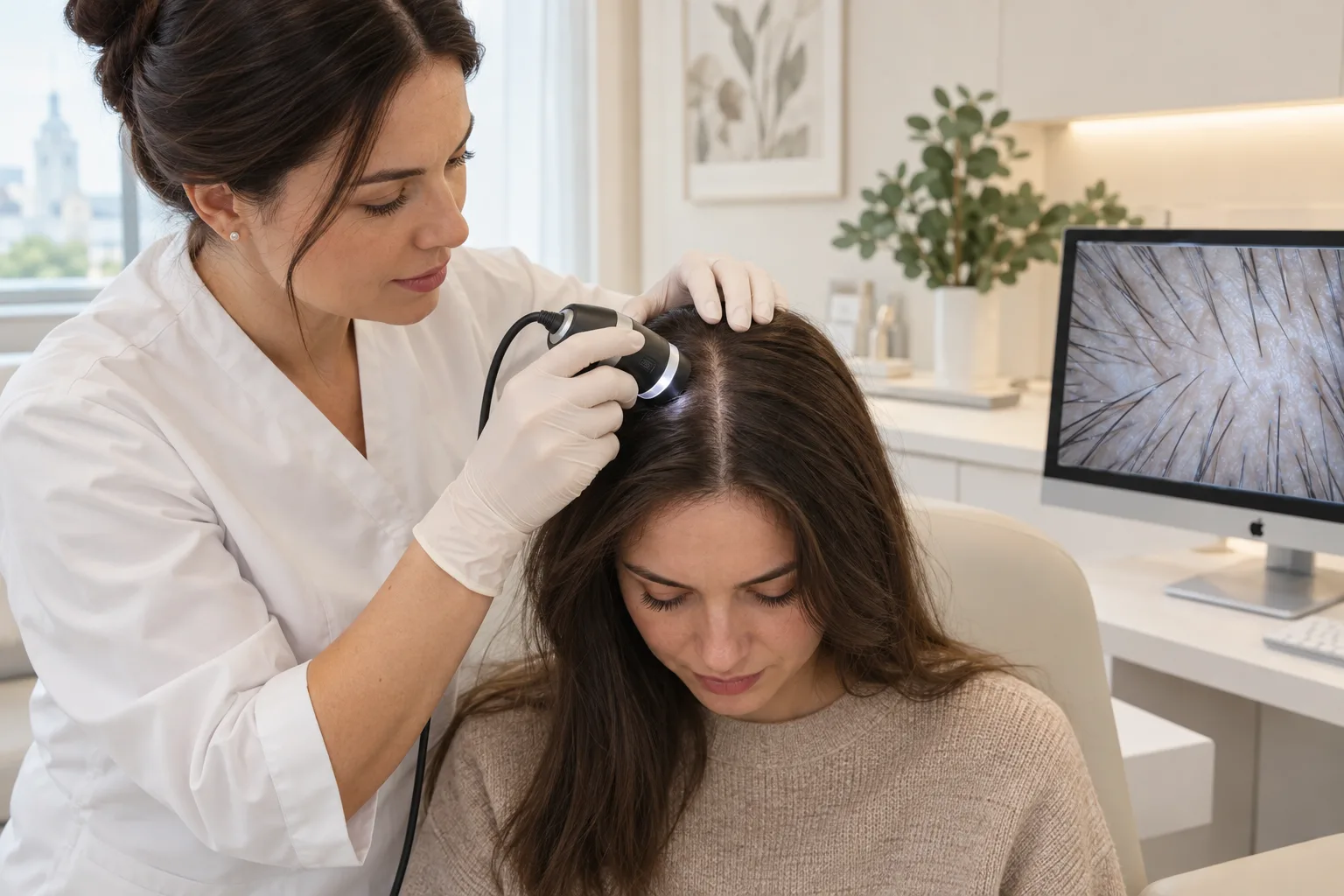
“My hair is falling out” is a symptom, not a diagnosis. During an initial trichologist consultation, the clinician asks when shedding began, how it has progressed, and about illness, surgery, pregnancy, diet and medication. The scalp, density, distribution of thinning and signs of inflammation are examined.
Trichoscopy can show variation in hair diameter, follicular openings, scaling and vascular or inflammatory signs. Laboratory tests are selected when the history and examination suggest a relevant cause; the same large panel is not necessary for everyone.
Sudden extensive shedding, pain, pustules, crusting or smooth areas without follicular openings should not be hidden behind a cosmetic procedure. Prompt diagnosis can affect the chance of preserving hair.
What happens during PRP treatment
The clinician first checks the indication, medical history, contraindications and scalp condition. Venous blood is drawn and processed under the selected protocol. Small injections are distributed through the planned area. Appointment length varies with the preparation system and treatment surface.
Needling, pressure or burning may be felt. Temporary pinpoint bleeding, tenderness, swelling, redness or bruising can occur afterwards. Increasing pain, spreading redness, discharge, fever or another unexpected symptom should be reported to the clinic.
Hair cycles are measured in months, so an immediate change is not biologically realistic. Standardised photographs, the same parting and lighting, and repeat trichoscopy provide more useful follow-up than counting hairs after a single shower.
How many sessions are needed?
There is no universally accepted schedule for every PRP system and diagnosis. Studies commonly use an initial series spaced several weeks apart and then reassess whether maintenance is worthwhile. A fixed package should not replace diagnosis or response monitoring.
| Stage | What is happening | Useful measurement |
|---|---|---|
| Baseline | Diagnosis and starting point are documented | Clinical images and trichoscopy |
| Early weeks | Existing hair cycles continue | Avoid judging treatment from day-to-day shedding |
| Following months | A response, if present, becomes gradual | Compare standardised images and density measures |
| Maintenance | Frequency differs and not everyone needs it | Consider the course of the underlying condition |
Outcome depends on diagnosis, duration, degree of miniaturisation, age, associated factors and concurrent treatment. PRP does not restore follicles that have been permanently replaced by scar tissue.
Preparation and safety
Tell the clinician about blood disorders, anaemia, cancer, autoimmune disease, acute infection, pregnancy, fainting, allergies and every medication or supplement. Never stop anticoagulants, antiplatelet medicines or anti-inflammatory drugs on your own. Any adjustment must be agreed with the prescriber and treating clinician.
Because the biological material is autologous, allergy to the plasma itself is less likely than with a foreign injectable. The procedure is not risk-free: pain, bleeding, bruising, swelling, infection and uncommon complications remain possible. Sterile technique, single-use materials, a traceable preparation protocol and medical supervision are essential.
PRP or another treatment?
The choice is not always PRP versus doing nothing. For androgenetic alopecia, a clinician may discuss medicines supported by more standardised evidence; suitability depends on sex, age, pregnancy plans and contraindications. A confirmed deficiency is corrected specifically rather than with random supplements. Active dermatitis or another inflammatory disorder is treated first.
PRP/PRF therapy at IYA Clinic can be included when the expected benefit fits the diagnosis and the patient’s priorities. A transparent plan also defines when to continue, modify or stop the course.
Frequently asked questions
Does PRP stop hair loss permanently?
No. It does not permanently remove genetic susceptibility or every cause of alopecia. Any benefit may require maintenance and control of the underlying condition.
Can PRP regrow hair on a completely bald area?
It cannot create new follicles. Expectations should be particularly limited where follicular structures have been destroyed or replaced with scar tissue.
Are PRP and “plasma lifting” the same?
Marketing terms are used inconsistently. The preparation system, product characteristics, sterility, diagnosis and injection protocol matter more than the label.
Do I need blood tests first?
There is no single panel for everyone. Tests are selected from the history, symptoms, examination and safety requirements of the planned procedure.
Can PRP be combined with other hair-loss treatments?
Sometimes. It may accompany medical therapy or other procedures, but compatibility, sequence and intervals should be set by a clinician.
When should hair loss be assessed promptly?
Seek diagnostic care for sudden patchy or extensive loss, pain, active inflammation, pustules, crusting or smooth scar-like areas rather than starting with a cosmetic injection.
This article is educational and does not replace a medical consultation. PRP should only be performed after individual assessment of indications and contraindications.
Sources for medical review
- American Academy of Dermatology. Hair loss: diagnosis and treatment.
- Donnelly C, et al. The role of platelet-rich plasma in androgenetic alopecia: a systematic review. J Cosmet Dermatol. 2024;23(5):1551–1559.
- Gupta AK, et al. Effectiveness of Platelet-Rich Plasma in the Treatment of Androgenic Alopecia: A Meta-Analysis. Dermatol Surg. 2024.
- Oliveira AFQ, et al. Use of autologous platelet-rich plasma in androgenetic alopecia in women: a systematic review and meta-analysis. J Dermatolog Treat. 2023.