iya clinic
Tummy tuck or liposuction: choosing abdominal contour surgery
 14.09.2026
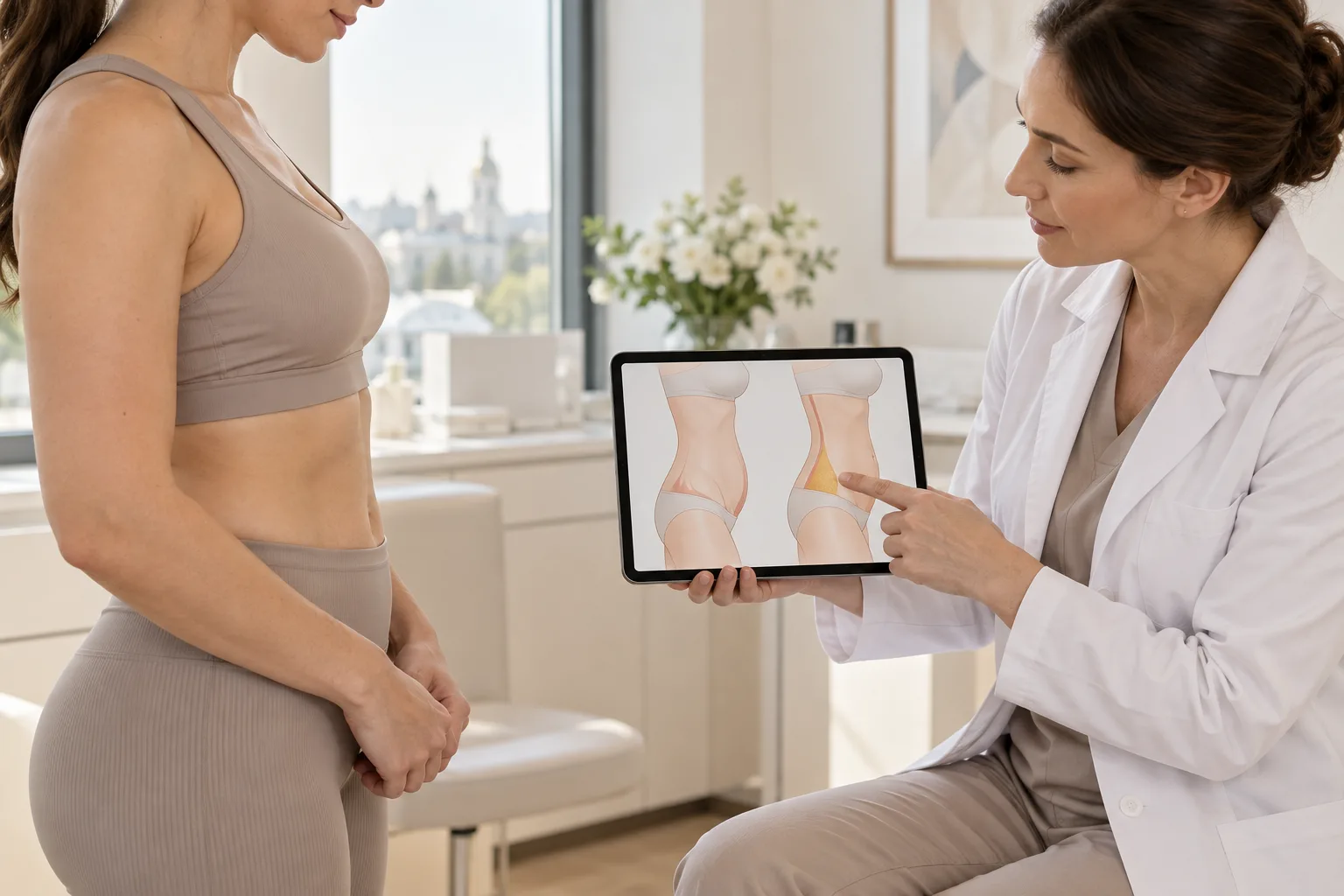
A tummy tuck and liposuction reshape the abdomen in different ways. Liposuction reduces local subcutaneous fat but does not remove substantial loose skin or repair separated rectus muscles. Abdominoplasty addresses the abdominal wall more comprehensively, but it is a larger operation and leaves a longer scar.
At IYA Clinic in Kyiv, selection between abdominoplasty and VASER abdominal liposuction follows examination of weight stability, skin quality, diastasis, hernias and the patient’s priorities.
What liposuction treats
Liposuction contours local fat deposits. Results are more predictable when body weight is stable and skin can contract after volume reduction. It is not general weight-loss treatment. If skin is significantly stretched after pregnancy or major weight loss, fat removal can make the excess more visible.
What abdominoplasty treats
Abdominoplasty removes a planned amount of lower abdominal skin and fat. Where indicated, the surgeon repairs diastasis and repositions the umbilicus. Full and mini abdominoplasty are not interchangeable labels. The operation cannot remove visceral fat and does not guarantee a perfectly flat abdomen.
Direct comparison
| Criterion | Liposuction | Abdominoplasty |
|---|---|---|
| Main target | Local subcutaneous fat | Loose skin and, where indicated, diastasis |
| Skin | Must contract by itself | Excess is surgically removed |
| Diastasis | Not repaired | May be repaired |
| Scars | Small access scars | Longer low scar, sometimes around the navel |
| Recovery | Usually shorter | Longer with more restrictions |
| Purpose | Contouring, not weight loss | Reconstruction of abdominal contour |
Which concern is dominant
A fold of empty skin visible when standing and bending usually cannot be corrected with liposuction alone. With elastic skin and a local fat pocket, lipomodelling may be considered. A midline bulge during strain can suggest diastasis, although examination and sometimes ultrasound are needed.
| Situation | More commonly discussed option |
|---|---|
| Elastic skin and local fat | Liposuction |
| Loose skin and lower abdominal stretch marks | Abdominoplasty |
| Post-pregnancy diastasis | Abdominoplasty with repair if indicated |
| Fat plus substantial loose skin | A combined plan |
| Unstable weight or planned pregnancy | Surgery is often postponed |
Can procedures be combined?
Abdominoplasty may be combined with liposuction of the flanks, lower back or selected abdominal areas. Combination does not mean maximising every component. The surgeon considers anaesthetic time, blood loss, thrombosis risk, tissue perfusion and medical conditions.
Scars, recovery and expectations
Liposuction leaves small access marks. A full tummy tuck produces a longer low scar designed to sit beneath underwear; length follows the amount of loose skin. It is initially pink and firm and matures over months. Final contour is assessed after swelling subsides, while major weight change or future pregnancy can alter it.
Tell the surgeon about previous operations, caesarean delivery, hernias, thrombosis, smoking, medication and supplements. Discuss the acceptable scar and practical support during recovery. IYA Clinic surgical operations are performed at MIRUM Clinic, 1 Viktora Nekrasova Street, Kyiv.
Safety assessment and alternatives
Preoperative assessment is not a formality. The surgeon reviews blood tests, anaesthetic risk, venous thrombosis risk, wound-healing factors and whether abdominal fullness comes from subcutaneous fat, visceral fat, muscle separation or a hernia. Smoking, uncontrolled diabetes, unstable weight and some cardiovascular conditions can materially increase risk and may need correction before surgery.
Not every patient who dislikes the abdominal contour needs an operation. A stable nutrition and activity plan may be the appropriate first step when weight is changing. Physiotherapy can improve function in selected patients with abdominal-wall weakness, although it cannot remove loose skin. Non-surgical energy treatments may offer modest skin-quality changes in carefully selected cases, but they should not be presented as an equivalent to surgical skin removal or muscle repair.
During consultation, ask what tissue will be treated, where scars will sit, whether the navel or muscle layer is involved, what support is needed at home and how complications are managed. A safe recommendation may also be to postpone surgery or reduce its extent.
Frequently asked questions
Can liposuction remove an apron of skin?
No. It reduces fat; substantial loose skin needs a different approach.
Is a tummy tuck a weight-loss operation?
No. Its purpose is abdominal contour and wall anatomy. Stable weight supports safety and durability.
Is the navel always repositioned?
No. It depends on anatomy and procedure extent. It is common in full abdominoplasty, while mini procedures differ.
Can liposuction repair diastasis?
No. Diastasis requires separate assessment of width, symptoms, hernias and pregnancy plans.
When can surgery be planned after pregnancy?
After early postpartum recovery, lactation and weight have stabilised. The surgeon sets an individual interval.
Does fat return after liposuction?
Removed cells do not return in the same number, but remaining cells enlarge with weight gain and proportions can change.
This article is educational. The plastic surgeon determines the operation after in-person examination and risk assessment.