
iya clinic
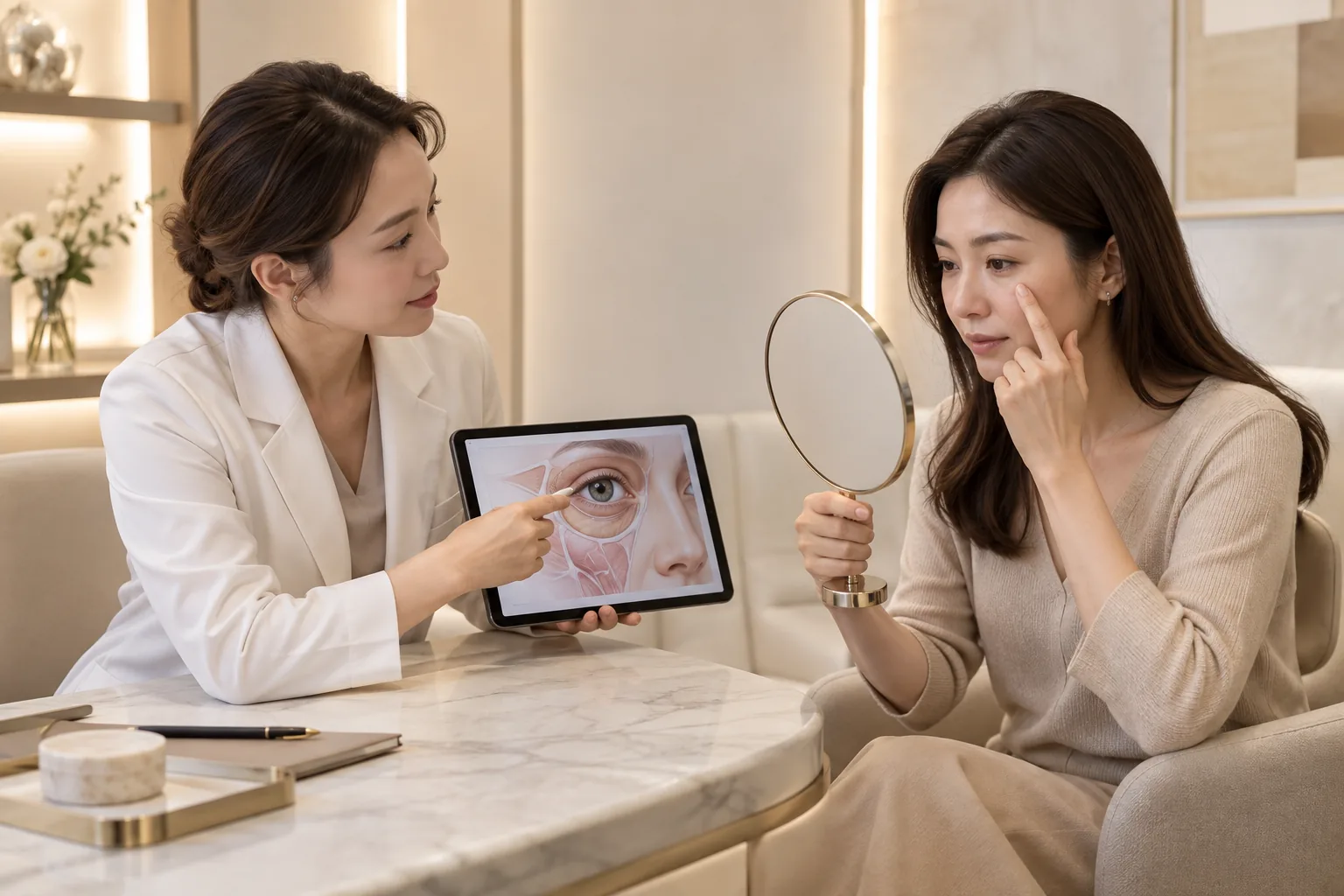
Poly-L-lactic acid under the eyes: why this area needs extra caution
 18.09.2026
“Dark circles” may reflect volume loss, pigment, visible vessels, oedematous bags, thin skin or several factors together. Poly-L-lactic acid is therefore not a universal under-eye solution.
PLLA and related collagen stimulators trigger a gradual tissue response rather than simply filling a groove with a ready-made gel. Thin skin, movement, complex vascular anatomy and a tendency to swell make the periorbital area highly dependent on product, depth and technique. IYA Clinic offers different aesthetic medicine approaches, but none should be selected by product name alone.
Identify the cause first
| Concern | Possible cause | Why an injection may not solve it |
|---|---|---|
| Blue circles | Vessels visible through thin skin | More volume does not remove vascular colour |
| Brown colour | Pigmentation | A biostimulator is not pigment treatment |
| Tear trough | Anatomy or tissue descent | The cheek, ligaments and orbit must be assessed |
| Morning bags | Oedema tendency or fat prolapse | Added product may accentuate volume |
| Fine lines | Dryness, photodamage or movement | Skin quality needs a broader plan |
Assessment includes frontal and profile views, changing light and facial animation. Previous fillers, eyelid surgery, allergy, immune conditions, medicines and swelling history matter.
How PLLA works
PLLA particles are placed in tissue using a product-specific protocol. The initial carrier volume subsides, while collagen-related changes develop over weeks and months. The immediate appearance is not the final outcome.
Gradual change can benefit selected facial areas. However, PLLA cannot be dissolved with hyaluronidase as hyaluronic acid can. An unwanted nodule or excessive response may therefore be difficult and slow to correct.
Why the eye area is different
Thin periorbital skin can reveal small irregularities. Fluid easily changes the contour, while nearby vessels make anatomical precision crucial. Published reports describe papules, nodules, granulomatous reactions and persistent swelling after collagen stimulators in this area.
Risk differs between products; PLLA and PDLLA are not identical. Indication, dilution, depth, volume and technique all matter. A small study of one formulation does not make every lactic-acid product interchangeable or override its official instructions.
Potential adverse effects
- bruising, tenderness and transient swelling;
- asymmetry or unwanted fullness;
- visible or palpable nodules;
- inflammation or infection;
- prolonged oedema;
- rare but urgent vascular events, including visual impairment.
Sudden severe pain, pallor or mottled skin, eyelid droop or any visual change after injection requires emergency medical care.
Alternatives depend on the diagnosis
| Primary issue | Option that may be discussed | Limitation |
|---|---|---|
| Volume loss | Mid-face support, cautious filler or another strategy | Filler also carries oedema and vascular risk |
| Pigmentation | Photoprotection, skincare and dermatologic treatment | Pigment causes vary |
| Vascular blue tone | Appropriate light or laser treatment | Skin tone and vessel type matter |
| Dynamic lines | Botulinum toxin when indicated | Does not correct pigment or a trough |
| Excess skin or fat pads | Plastic surgery consultation | Devices and injectables do not replace surgery |
| General skin quality | Delicate device or injectable protocols | Must account for thickness and swelling |
Questions for the consultation
Ask for the exact product and composition, whether it is indicated for the proposed area, the clinician’s experience, the intended tissue plane and the complication plan. Report every previous injection, even from years ago, and document the baseline without filters.
Choosing not to inject may be the safest expert recommendation. In an oedema-prone face or with prominent fat pads, adding product can be counterproductive.
Frequently asked questions
Can PLLA be injected directly into the tear trough?
It depends on the specific product, instructions, anatomy and technique. Classical PLLA in the periorbital region warrants particular caution because nodules can be visible.
When is the result visible?
Biostimulation develops gradually. Early fullness partly reflects the carrier and is not the final result.
Can PLLA be dissolved?
No, hyaluronidase does not dissolve PLLA. Prevention, patient selection and experienced technique are therefore essential.
What if a nodule develops?
Do not aggressively massage it without advice. It needs clinical review; ultrasound can sometimes assist diagnosis, and management depends on the type of reaction.
This information is educational. Periorbital injections should only be performed by a qualified medical clinician after in-person anatomical and risk assessment.


